Not necessarily.
A sale without legal warranty does not automatically mean that there is a problem with the property. But it does change the level of protection available to the buyer.
The important questions are:
Why is the seller excluding the legal warranty? What protection are you giving up? And what can you do to better understand and manage the risk?
What is a Legal Warranty?
In Quebec, the legal warranty includes two main components: the Warranty of Ownership and the Warranty of Quality.
For most home buyers, the one that comes up most often is the Warranty of Quality.
In simple terms, when a property is sold with the legal warranty of quality, the buyer may have legal protection against certain Latent Defects (vice caché / hidden defects).
This warranty exists by law; it does not have to be specifically added to the contract in order to apply.
What qualifies as a Latent Defect?
Not every problem discovered after purchasing a property is considered a Latent Defect.
Generally, several important elements need to be present.
The defect must have existed at the time of the sale, the buyer must not have known about it, and it must not have been an obvious defect that a prudent and diligent buyer should reasonably have discovered before purchasing.
The problem must also be serious enough that, had the buyer known about it beforehand, they might not have purchased the property — or might not have agreed to pay the same price.
In other words:
Discovering a problem after buying a property and having a legal Latent Defect claim are not the same thing.
Why Are Some Properties Sold Without Legal Warranty?
This is an important distinction:
Without Legal Warranty ≠ There is necessarily something wrong with the property.
A seller may choose to exclude the legal warranty for several different reasons.
01 | Succession / Estate Sale
When a property is being sold as part of an estate, the person responsible for the sale may never have lived in the property.
They may therefore have limited knowledge of its history, previous repairs or overall condition.
In this situation, the seller may not want to provide a legal warranty for a property they do not know particularly well.
Succession and repossession sales are examples of situations where a property may be offered without legal warranty.
02 | Older or Retired Sellers
Some owners are older or retired and simply want the sale to represent the end of their responsibility for the property.
They may not want to deal with potential claims relating to the property years after they have sold it.
As a result, a seller may choose to sell without legal warranty even when there is no particular known issue with the property.
03 | Market Conditions — Something I Have Observed in Recent Years
There is another situation I have noticed through my own work in the Montreal market.
During the pandemic, Montreal experienced an exceptionally strong seller’s market. Multiple offers and significant overbidding became very common.
In that environment, some sellers chose to sell without legal warranty even when the decision was not necessarily connected to a known problem with the property.
I have seen this practice continue in some transactions since then.
So when I see that a property is being sold without legal warranty, I don't automatically assume there is something wrong with it.
My first question is: Why has the seller chosen to exclude the legal warranty?
What Does “Without Legal Warranty” Mean for a Buyer?
If you agree to exclude the seller’s Legal Warranty of Quality, your ability to pursue that seller if certain problems are discovered after the purchase can be significantly affected.
That makes due diligence even more important when considering a property sold without legal warranty.
01 | Tell the Inspector That the Property Is Being Sold Without Legal Warranty
Before the inspection, I let the inspector know when the property is being sold without legal warranty.
OACIQ also recommends a more thorough pre-purchase inspection when purchasing a property without the Legal Warranty of Quality.
If the inspection identifies something that requires further investigation, the next step may be to bring in an appropriate specialist, depending on the nature of the issue.
02 | Understand Why the Seller Is Excluding the Warranty
This is something I pay particular attention to.
“Without legal warranty” is a condition of the transaction. The reason behind it can help us understand what deserves closer attention.
Is it a succession?
Has the seller never lived in the property?
Is it an older owner who simply does not want continuing liability after the sale?
Was the property itself previously purchased without legal warranty?
Different circumstances may call for different questions and different levels of investigation.
03 | Review the Seller’s Declaration and Property History Carefully
The Seller’s Declaration is an important document in any residential transaction, but it deserves particularly careful attention when a property is being sold without legal warranty.
I look at what has been disclosed about the property's history — previous water infiltration, flooding, repairs, insurance claims or other known issues — as well as how much the seller actually knows about the property.
This information can also help determine what deserves additional attention during the inspection and whether further investigation is appropriate.
Does This Mean You Shouldn't Buy a Property Without Legal Warranty?
No.
I would not advise a buyer to automatically reject a property simply because it is being sold without legal warranty.
Instead, I would want to understand:
Why is the legal warranty being excluded?
What is the actual condition of the property?
What does the Seller’s Declaration tell us?
What did the inspection reveal?
Is there anything that should be investigated further by another professional?
And:
Is the additional risk reflected appropriately in the price and offer strategy?
The exclusion of the legal warranty can also affect buyer interest in a property.
From a practical market perspective, some buyers simply won't consider properties sold without legal warranty. In certain circumstances, that can mean less competition for the property.
That doesn't automatically make it a good deal.
But for a buyer who has done the appropriate due diligence and understands the condition of the property and the risks involved, the absence of legal warranty does not necessarily have to be a deal breaker.
An Important Detail: The Legal Warranty of Previous Sellers
This is something many buyers may not realize.
A commonly used clause in the past was:
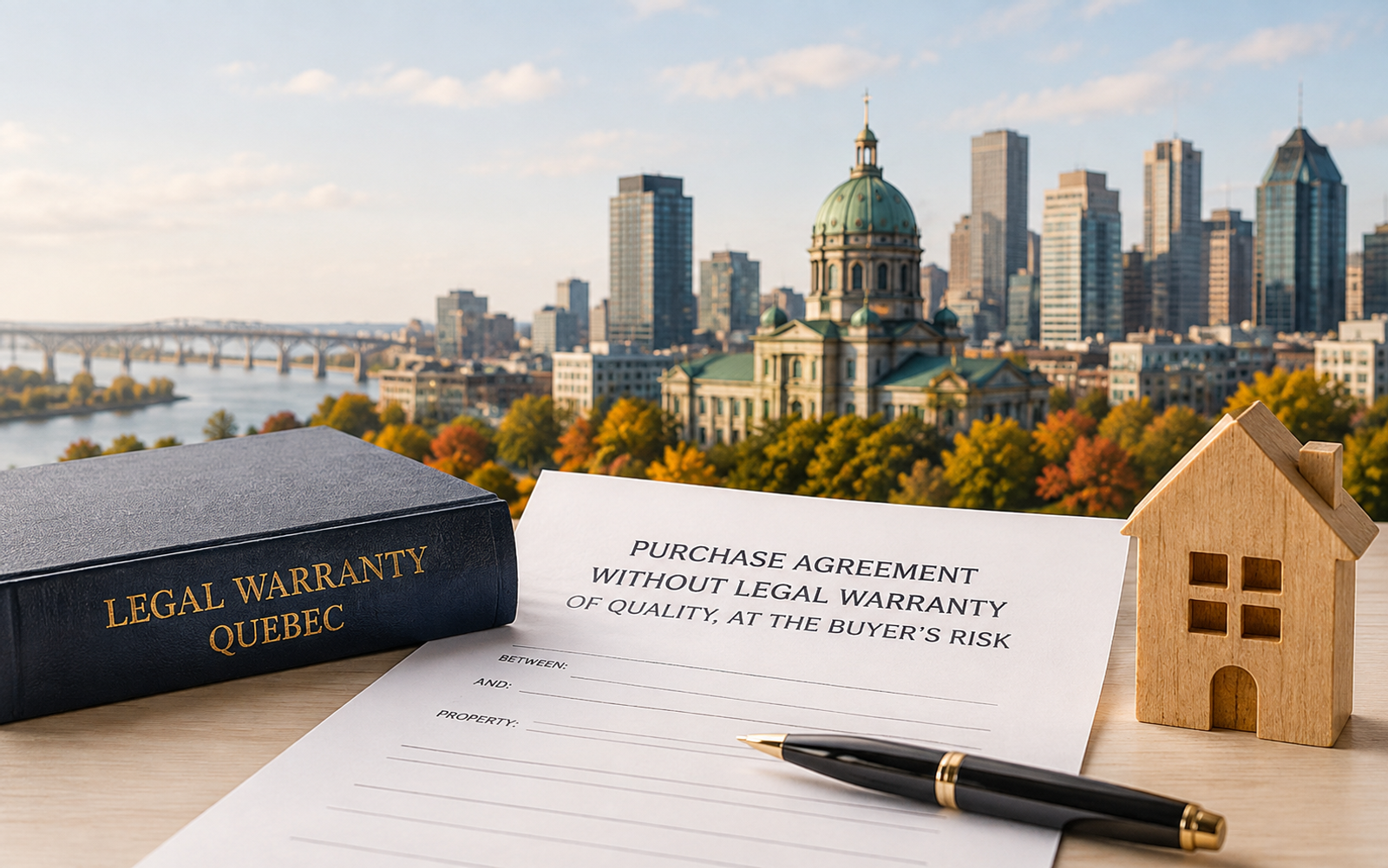
“Without legal warranty, at the buyer’s own risk.”
But a broad exclusion of the legal warranty may do more than prevent you from pursuing your immediate seller. It may also affect your ability to benefit from legal warranties originally provided by previous sellers in the property's chain of ownership.
Quebec Court of Appeal decisions have had an important impact on this issue, and current OACIQ guidance draws brokers' attention to the wording used when excluding the legal warranty.
That means when dealing with a property sold without legal warranty, the wording of the clause matters.
Where appropriate, the exclusion can be structured to apply specifically to the immediate seller, rather than unnecessarily giving up legal warranties that may have been provided by previous sellers.
A Recent Transaction I Handled for My Buyers
I recently represented buyers purchasing a property being sold without legal warranty, and we specifically addressed this issue in the transaction.
My buyers accepted that the immediate seller would not provide the Legal Warranty of Quality, while the clause preserved their rights to the legal warranties that may have been provided by previous sellers.
On paper, the difference may look like only a change in the wording of a clause.
For the buyers, however, it meant preserving a layer of legal protection that could otherwise have been given up.
So when I deal with a property being sold without legal warranty, the question isn't simply:
“Should we buy it?”
It is also:
“What exactly are we giving up — and what rights can we preserve?”
If You're Buying a Home in Montreal
As a Buyer’s Broker, I can guide you through the process — from property visits and reviewing the property and its documents, to preparing the offer, inspection, due diligence and completing the transaction.
If you have any questions about buying a property, feel free to contact me.