First-time home buyer in Quebec in 2026?
Eligible first-time home buyers in Quebec may qualify for a refundable tax credit against the Welcome Tax they paid, up to $5,875. Eligibility and the actual amount depend on your circumstances and the property.
Step 1 | Confirm Your Eligibility & Mortgage
Can you buy property in Canada?
If you are a Canadian citizen or permanent resident, the current federal Foreign Buyer Ban generally does not apply to you.
If you are not a Canadian citizen or permanent resident, confirm your eligibility before beginning your property search.
The federal prohibition on certain purchases of residential property by non-Canadians is currently in effect until January 1, 2027, although there are exemptions depending on immigration status, property type and location.
If you're unsure whether the rules apply to you, get advice based on your specific situation before making an Offer.
How much can you afford?
Before seriously looking at properties, I recommend speaking with a bank or Mortgage Broker and obtaining a Mortgage Pre-Approval.
For a typical owner-occupied property under $1.5 million, the current minimum down payment is:
$500,000 or less
5% minimum down payment
Over $500,000 and under $1.5 million
5% on the first $500,000
+ 10% on the remaining amount
For example, on an $800,000 property:
$500,000 × 5% = $25,000
$300,000 × 10% = $30,000
Minimum down payment: $55,000
If your down payment is less than 20%, mortgage loan insurance is generally required. Properties priced at $1.5 million or more are not eligible for CMHC mortgage insurance and generally require at least 20% down.
Buying an investment property? Financing requirements are different, and you will generally need at least a 20% down payment. Speak with your bank or Mortgage Broker for advice based on your situation.
A small tip before you buy
If you're planning to buy a property soon, avoid taking on new debt before your purchase is completed.
For example, financing a new car or taking out a large personal loan can increase your monthly debt obligations and may affect how much mortgage financing you qualify for — even if you already have a Mortgage Pre-Approval.
Your financial situation can be reviewed again before final mortgage approval, so try to keep it stable throughout the buying process.
Planning a major purchase? Speak with your Mortgage Broker or bank first.
Step 2 | Work With a Buyer’s Broker
Once you understand your budget, you can start looking seriously.
A Buyer’s Broker does much more than find listings and arrange visits.
From analyzing the property and comparable sales to reviewing the Seller’s Declaration and other documents, preparing and negotiating your Offer, navigating Inspection and Financing conditions, and coordinating the transaction through closing, your broker represents your interests throughout the process.
My role is also to help you understand:
What are we looking at?
What deserves closer attention?
What happens next?
→ Learn About My Buyer Representation Service
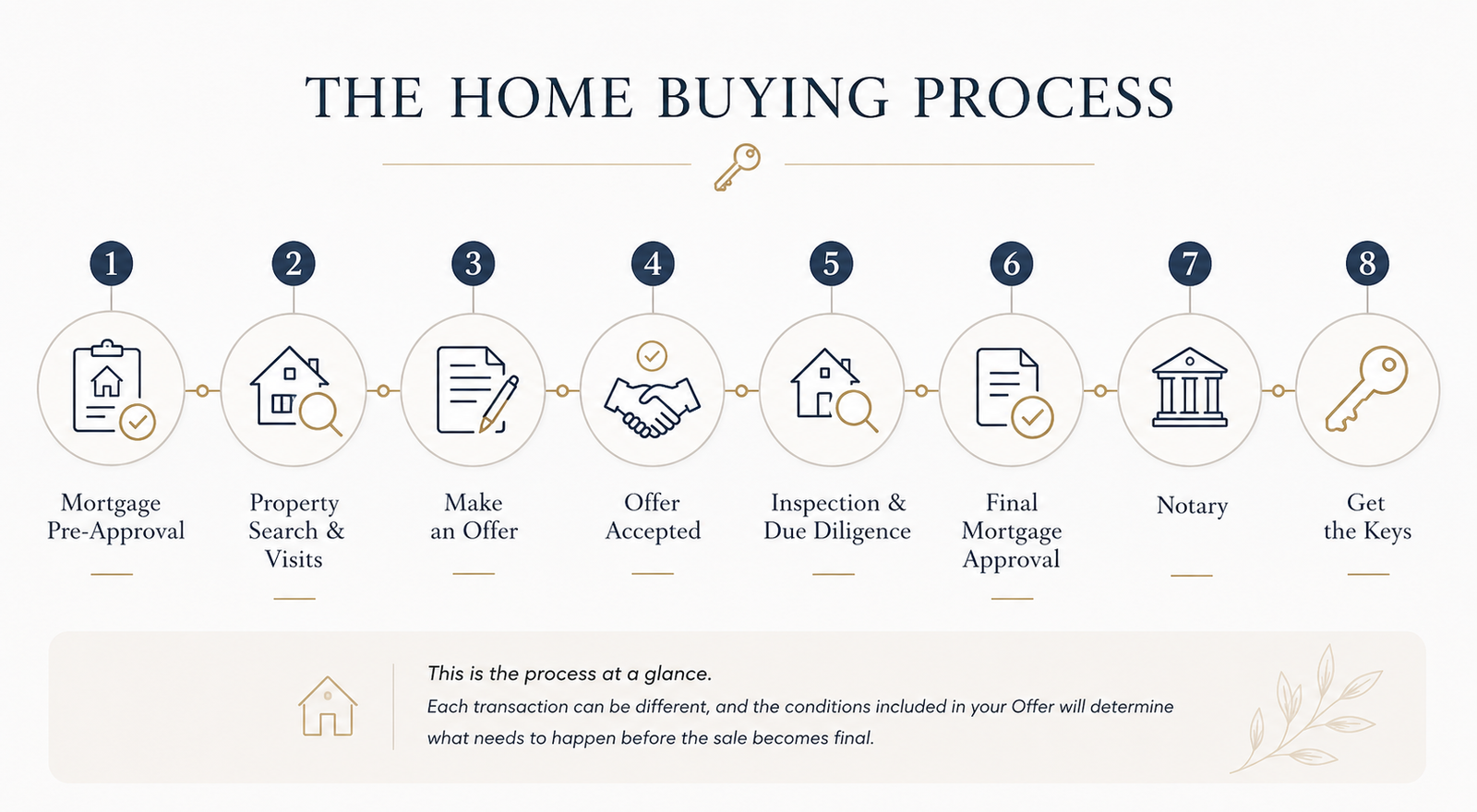
The Home Buying Process at a Glance
01 Mortgage Pre-Approval →
02 Property Search & Visits →
03 Make an Offer →
04 Offer Accepted →
05 Inspection & Due Diligence →
06 Final Mortgage Approval →
07 Notary →
08 Get the Keys
Every transaction is different. The conditions included in your Offer will determine the steps that need to be completed before closing.
Step 3 | Understand the Real Cost of Buying a Home
Your down payment isn't the only amount you need to prepare.
Before and around closing, you should budget for expenses such as:
Down payment, notary fees, inspection fees and other transaction-related costs.
After purchasing the property, you will also receive your Welcome Tax (property transfer duties) from the municipality.
Once you become a homeowner, there are ongoing expenses to consider as well:
Municipal taxes, school taxes, home insurance, utilities, regular maintenance and repairs.
If you're buying a condo, you'll have many of the same expenses, plus:
Condo fees and potentially Special Assessments.
So rather than asking only:
“How much do I need for the down payment?”
Think about the bigger picture:
Down Payment + Buying Costs + Ongoing Ownership Costs
If you're buying a condo, it's also important to understand the syndicate's financial health, contingency fund, self-insurance fund and any upcoming major work.
→ Read: Buying a Condo in Montreal — What Should You Know?
Step 4 | Keep Your Property Records From Day One
This is something many buyers don't think about when purchasing a home, but it can become extremely useful years later.
From the day you become the owner, keep records of important work completed on the property.
For example:
Renovations, roof replacement, windows, plumbing, electrical work, foundation or waterproofing work, heating and cooling systems, and other significant repairs or improvements.
Keep the related invoices, warranties, permits and supporting documents.
Years later, when you decide to sell, a buyer may ask:
When was the roof replaced?
Who completed the work?
Is there an invoice?
Is the warranty still valid?
Having proper records is much more useful than trying to remember what was done five or ten years ago.
These documents can also help when completing the Seller’s Declaration and answering questions about the property's history.
Create a Property File from Day One.
Keep your important invoices, warranties, permits, Inspection Report, notarial documents and major maintenance records together.
It can make owning — and eventually selling — your property much easier.
Ready to Start?
You don't need to understand every part of a Quebec real estate transaction before you begin.
That's what I'm here for.
Whether you're still figuring out your budget, starting your property search, or already have a property in mind, I can walk you through the process — from understanding your options and evaluating properties to making an Offer and completing the purchase.
Thinking about buying a home in Montreal?
Book a consultation and let's talk about where you are in the process.
Understand first. Decide with confidence.